
Your First 90 Days as a Manager: The Only Guide You Actually Need
You weren’t hired to prove yourself. You were hired to lead. Here’s the difference.

You get the promotion.
You say thank you. You smile. You probably feel proud for about 48 hours.
Then Monday arrives.
You sit down at your desk — the same desk, in the same office, with the same people around you — and something feels completely different. Because now they’re not your colleagues anymore.
They’re your team.
And nobody told you what to do next.
Most first-time managers spend their first 90 days trying to prove they deserve the role. They overwork. They over-answer. They over-commit. They mistake busyness for leadership.
And slowly — sometimes quietly, sometimes not — things start to break.
Not because they’re bad managers.
Because nobody gave them a map.
This is that map.
The one shift that changes everything in your first 90 days
Here’s the insight I wish someone had handed me on day one:
Your first 90 days are not about performing leadership. They’re about understanding the room you just walked into.
That’s it.
Not impressing your boss. Not fixing everything at once. Not proving you were the right choice.
Understanding the room.
What does the team actually need from a leader right now? What’s broken that nobody talks about? What’s working that you shouldn’t touch? Who has the informal power? What does trust look like in this particular group of people?
You can’t lead well without those answers. And you can’t get those answers without slowing down first.
Every manager who rushes into action in their first 90 days — changes processes, restructures meetings, rewrites expectations — pays for it later. Not because the changes were wrong. But because they made them before anyone trusted them enough to follow.
Clarity before action. Understanding before change.
That’s the map.
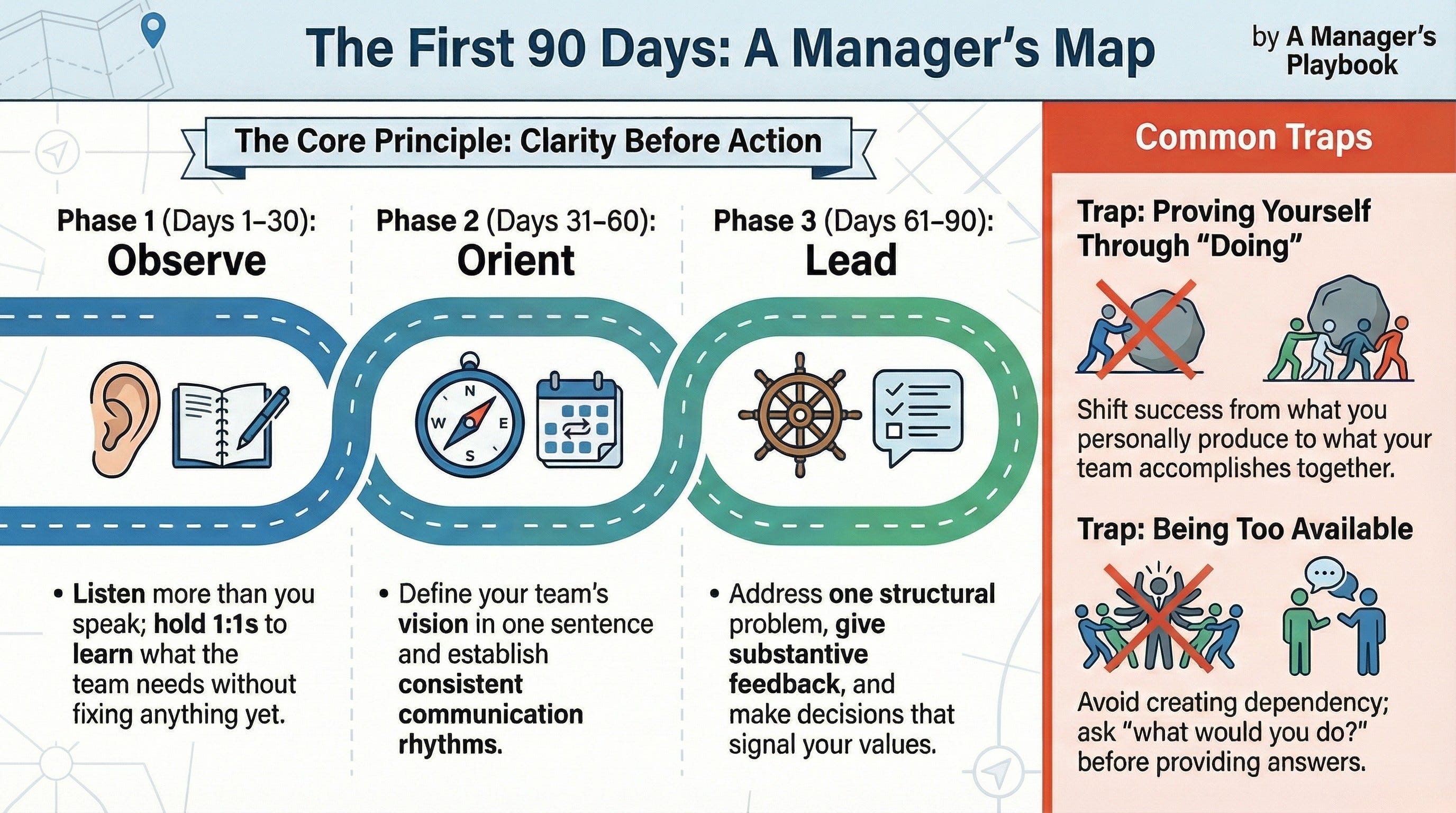
The 3-phase framework: Observe, Orient, Lead
Your first 90 days have a natural shape. Most managers skip the first two phases and jump straight to the third. That’s the mistake.
Phase 1: Observe (Days 1–30)
Your job in the first 30 days is to listen more than you speak.
Not passive listening. Active listening — with intention. You’re building a picture of the team, the culture, the unspoken rules, and the real problems underneath the official ones.
What to do in the first 30 days:
Hold a one-on-one with every person on your team within the first two weeks. Not a performance conversation. A getting-to-know-you conversation. Ask what’s going well, what’s hard, what they wish was different, and what they need from a manager.
Sit in every recurring meeting once before you change anything about them.
Read any existing documentation, goals, or performance notes before forming opinions.
Resist the urge to fix anything for 30 days. Write down what you notice instead.
The questions to ask in every early 1:1:
What does a good week look like for you in this role?
What’s one thing that slows you down that I might be able to help with?
What did you like most about how the team operated before?
What’s one thing you’d change if you could?
What do you need from a manager to do your best work?
Listen for the gaps between what people say and what they mean. That gap is where the real leadership work lives.
If you want a full framework for running those first 1:1 conversations, I wrote a step-by-step guide here: 👉 How to Run a 1:1 Meeting as a New Manager
Phase 2: Orient (Days 31–60)
By day 30, you have a picture. Now your job is to make sense of it.
Orienting means taking what you’ve observed and translating it into clarity — for yourself first, then for your team. What does this team actually need to do well? What are the 2–3 things that would make the biggest difference? Where are the gaps between where things are and where they should be?
This is also the phase where you establish your rhythm — the operating system of how you lead.
What to do in days 31–60:
Define your team’s vision in one sentence. Not a 5-year plan. One sentence that answers: “What does success look like for us in the next 6 months, and why does it matter?” Write it down. Share it.
Set up a consistent 1:1 cadence with each team member. Weekly if possible. At least bi-weekly.
Establish your communication norms: how you prefer to be reached, when you’re available, how you handle urgent vs non-urgent requests.
Have one honest conversation with your manager about your priorities. What does success look like for you in this role, from their perspective?
Copy-paste: Your team vision statement template
“In the next [X months], our team will [specific outcome]. That means we’ll focus on [priority 1], [priority 2], and [priority 3]. A win looks like [concrete definition of success].”
Keep it short. Keep it specific. Say it out loud in your next team meeting. Then say it again in every 1:1. Vision lands through repetition, not revelation.
For a deeper guide on how to communicate direction without corporate jargon: 👉 The 5 Minute Team Talk that Replaces Your Missing Vision
Phase 3: Lead (Days 61–90)
By day 60, your team knows you’re listening. They know what you stand for. They trust you enough to follow.
Now you lead.
This is when you make the changes you identified in Phase 1. Address the problems you heard about in your 1:1s. Remove blockers. Give feedback. Set expectations. Build the culture deliberately instead of letting it happen by accident.
Not everything at once. One thing clearly, then the next.
What to do in days 61–90:
Run a 30/60/90-day review with each person on your team. What have they accomplished? What’s working? What needs to shift going forward?
Address one structural problem you identified in Phase 1 — a broken process, an unclear role, a recurring frustration. Fix it. Make it visible.
Give your first piece of substantive feedback to at least two people on your team. Specific, kind, and actionable.
Onboard properly — if you have new team members, create a clear 30-day structure for them.
On giving feedback that actually changes behavior rather than creating defensiveness: 👉 Feedback That Lands
On setting up onboarding that builds confidence from day one: 👉 Why Your New Hire is Still Confused After Week One
The 5 traps every new manager falls into — and how to avoid them
Trap 1: Proving yourself through doing, not leading
You were promoted because you were good at the work. Your instinct is to keep doing the work — and do it better than everyone else.
But your job changed. You’re not the best individual contributor on the team anymore. You’re the person who makes the whole team better.
The shift: measure your success by what your team accomplishes, not what you personally produce.
Trap 2: Being too available
In the first 90 days, you want everyone to like you. So you say yes to everything. Every question, every request, every impromptu meeting.
This feels like support. It’s actually dependency.
The more you solve problems for your team, the less they learn to solve problems themselves. And the less energy you have to do the actual work of leadership.
The shift: ask “what would you do?” before you give an answer.
On setting boundaries without guilt — and the copy-paste scripts to do it: 👉 Why Saying Yes to Everything is Making You Worse at Your Job
Trap 3: Waiting to feel ready before leading
Most new managers spend the first 90 days waiting for confidence to arrive before they start acting like a leader.
It doesn’t work that way.
Confidence comes from action, not the other way around. You become a leader by doing leadership things — making decisions, setting direction, giving feedback, having hard conversations — before you feel fully ready.
The shift: act from your values, not from your confidence level.
Trap 4: Skipping the hard conversations
There’s almost always something that needs to be said in the first 90 days — a performance issue, a team dynamic that’s off, an expectation that isn’t being met.
New managers delay these conversations because they don’t want to damage relationships before they’ve built them.
But silence is a message. It says: this is acceptable. And that’s a much harder message to walk back later.
The shift: address small issues early when they’re still small. A 5-minute conversation now saves a 50-minute crisis later.
Trap 5: Going it alone
You feel like you should have the answers. So you don’t ask for help. You don’t tell your manager when something is hard. You carry the weight of the role privately and wonder why it’s so heavy.
Leadership is a skill, not a personality trait. Every skill is learnable. But only if you seek feedback, ask questions, and let people help you.
The shift: your willingness to ask for help is a signal of strength to your team, not weakness.
On how to navigate the relationship with your own manager: 👉 Managing Up Without Being a Yes-Person
Your first 90 days checklist (copy-paste this)
Days 1–30: Observe
[ ] Schedule a 1:1 with every team member in week one
[ ] Ask all 5 listening questions in each early 1:1
[ ] Attend every recurring meeting once before changing anything
[ ] Write down 3 things you notice that seem off
[ ] Write down 3 things you notice that are working
[ ] Resist the urge to fix anything yet
Days 31–60: Orient
[ ] Write your team vision in one sentence
[ ] Share the vision in a team meeting
[ ] Set up a recurring 1:1 schedule with each team member
[ ] Define your communication norms and share them
[ ] Have a clarity conversation with your manager about your priorities
[ ] Repeat your vision in at least 3 different conversations
Days 61–90: Lead
[ ] Run a 30/60/90-day review with each team member
[ ] Fix one structural problem you identified in Phase 1
[ ] Give substantive feedback to at least two people
[ ] Make one decision that signals what you stand for
[ ] Ask your team: “What’s one thing I can do differently to help you?”
The 90-day conversation script — your manager relationship
One of the most underused tools in the first 90 days is a direct conversation with your own manager about what success looks like.
Most new managers assume they know. They don’t have the conversation. Six months later, they find out their manager had completely different expectations.
Have this conversation in week two. Use this script:
“I want to make sure we’re aligned on what a strong first 90 days looks like for me. From your perspective, what are the 2–3 things that would tell you I’m doing this role well? And is there anything specific you’d want me to avoid in this early period?”
Then listen. Write it down. Refer back to it.
Clarity from your manager in week two is worth more than six months of guessing.
What nobody tells you about the first 90 days
You will feel like you’re failing before you feel like you’re leading.
That’s normal. It’s not a signal that you’re wrong for the role. It’s a signal that you’re in the learning phase of something genuinely hard.
Every experienced manager you admire had a first 90 days where they felt underwater. The difference between managers who grow and managers who stall isn’t talent. It’s whether they stayed curious about what they needed to learn, or whether they defended how much they already knew.
Stay curious.
Ask more questions than you answer.
Lead from your values when your confidence is low.
And remember: your team isn’t looking for perfection. They’re looking for someone who shows up, listens, and cares.
You already have two of those three. The rest comes with time.
Before you close this:
Think about the first 90 days of your current or most recent leadership role. Which phase did you skip — Observe, Orient, or Lead?
What would have been different if you’d slowed down for 30 days first?
Write it down. That’s your most useful leadership lesson.
If you found this useful, the most practical next step is building out your 1:1 system — it’s the single most important habit in your first 90 days. I’ve put together a complete toolkit for it here:
👉 No More Awkward 1:1s — A Manager’s Playbook
Every Tuesday and Friday, I send one practical guide for first-time managers who want to lead well without burning out. Subscribe below if you want in.